
n the landscape of mental health treatment, the emergence of esketamine (SPRAVATO®) represents one of the most significant advances in decades for individuals battling treatment-resistant depression (TRD). For the estimated one-third of people with major depressive disorder (MDD) who find little relief from traditional oral antidepressants, this treatment offers a new, rapid-acting pathway to potential recovery. As a novel glutamatergic modulator, esketamine works differently than conventional serotonin-based drugs, providing hope where other treatments have failed. You can learn more about how this innovative therapy is administered under professional care at Brainiac Behavioral Health’s dedicated Esketamine Treatment service.
Understanding Treatment-Resistant Depression
Major depressive disorder is a leading cause of global disability, affecting an estimated 280 million people worldwide. Within this population, a substantial subset—up to 30-40%—develops TRD, defined as an inadequate response to at least two trials of antidepressants of adequate dose and duration. TRD is associated with profound suffering, including increased functional impairment, higher healthcare utilization, and a significantly elevated risk of suicide. Patients often endure a lengthy and demoralizing cycle of trying multiple medications, waiting weeks for each to potentially work, with diminishing chances of success.
The Science of Esketamine: A Different Mechanism of Action
Traditional antidepressants primarily target the brain’s monoamine systems (serotonin, norepinephrine, dopamine). Esketamine takes a fundamentally different approach. It is a non-selective, non-competitive antagonist of the N-methyl-D-aspartate (NMDA) receptor, a key component of the brain’s glutamate system.
Glutamate is the brain’s most abundant excitatory neurotransmitter. The prevailing theory suggests that by blocking NMDA receptors, esketamine triggers a cascade of neurobiological events. This includes increased release of glutamate, followed by activation of another receptor (AMPA), ultimately leading to enhanced synaptogenesis—the formation of new neural connections—in brain regions like the prefrontal cortex that are implicated in mood regulation. This rapid restoration of synaptic connectivity is believed to underlie the fast-acting antidepressant effects, a stark contrast to the weeks or months required for conventional drugs to take effect.
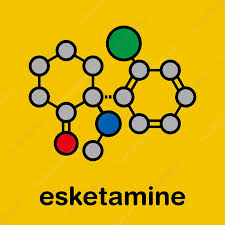
The key distinction from its parent compound, ketamine, is potency. Esketamine is the S-enantiomer of the ketamine molecule and has greater affinity for the NMDA receptor. This allows for effective antidepressant dosing at lower levels, and importantly, its formulation as a nasal sprayprovides a practical and controlled method of administration in a clinical setting.
Efficacy and Clinical Outcomes
The efficacy of esketamine has been evaluated in numerous clinical trials and real-world studies. In 2019, the U.S. Food and Drug Administration (FDA) approved intranasal esketamine, in conjunction with an oral antidepressant, for adults with TRD. More recently, in January 2025, the FDA expanded this approval, making esketamine the first and only monotherapy for adults with TRD, meaning it can be used effectively without being paired with a daily oral antidepressant.
The clinical data supporting these approvals demonstrate a rapid and meaningful impact on depressive symptoms:
- Rapid Onset: Improvement in depressive symptoms can be observed as early as 24 hours after the first dose, offering critical and fast relief for those in severe distress.
- Sustained Improvement: In the pivotal monotherapy study, esketamine showed superior improvement over placebo at the primary endpoint of 4 weeks. A post-hoc analysis indicated numerical improvements across all 10 items of the Montgomery-Åsberg Depression Rating Scale (MADRS) by day 28.
- Response and Remission Rates: A major 2025 systematic review and meta-analysis of 17 randomized controlled trials found that esketamine plus an oral antidepressant significantly improved both response (≥50% reduction in symptoms) and remission rates compared to placebo plus antidepressant. In the monotherapy trial, remission rates (MADRS score ≤12) at week 4 were 22.5% for the esketamine group versus 7.6% for the placebo group.
- Functional Recovery: Beyond symptom reduction, esketamine treatment has been associated with significant improvements in functional outcomes, as measured by scales like the Sheehan Disability Scale, helping patients regain their ability to engage in daily life.
For particularly difficult-to-treat populations, such as those experiencing depressive episodes with psychotic features, preliminary evidence is also promising. A 2025 systematic review found that (es)ketamine showed antidepressant effects in these patients with a reasonable safety profile, and importantly, there were no reports of psychotic symptom deterioration in the studies reviewed.
Safety, Side Effects, and the REMS Program
While effective, esketamine is a potent medication with a distinct side effect profile that necessitates careful management. Its use is governed by a stringent Risk Evaluation and Mitigation Strategy (REMS) Program mandated by the FDA. This program requires that esketamine is only administered in certified healthcare settings where patients can be monitored for at least two hours after each dose.
Common side effects are typically transient, occurring shortly after administration and resolving within the monitoring period. They include:
- Dissociation: A temporary feeling of detachment from one’s self or surroundings.
- Sedation/Dizziness: Feelings of sleepiness, fainting, or a spinning sensation.
- Increased Blood Pressure: A temporary rise in blood pressure and heart rate.
- Nausea.
Serious risks include potential for abuse and misuse (due to its psychoactive properties), respiratory depression, and increased suicidal thoughts and behaviors—a risk inherent to all antidepressant treatments, particularly in young adults.
Special Considerations for Older Adults: Post-marketing surveillance data highlights the need for extra caution in patients aged 65 and older. Analysis of the FDA Adverse Event Reporting System (FAERS) suggests that older adults may have a higher risk of severe psychiatric adverse events, including dissociation, suicidal ideation, and anxiety, compared to younger adults. This underscores the necessity for meticulous patient selection, dose adjustment, and monitoring in the elderly population.
Esketamine in Clinical Practice: A Structured Treatment Journey
Esketamine treatment is not a one-time event but a structured therapeutic process typically divided into two phases:
- Induction Phase (Weeks 1-4): Treatment is administered twice per week under clinical supervision. This intensive phase aims to achieve a significant and rapid reduction in depressive symptoms.
- Maintenance Phase (Month 2 and Beyond): Once a patient is stabilized, the frequency of treatment is gradually reduced—first to once weekly, and then potentially to once every two weeks or less—to maintain the therapeutic benefit.
Durability is a key consideration. Real-world observational studies indicate that while many patients sustain benefits with maintenance therapy, the intervals between required maintenance doses may vary. One 2025 study comparing intravenous ketamine to intranasal esketamine found that the time between maintenance treatments was longer for intravenous ketamine, suggesting differences in durability that warrant further study.
The Future: Beyond Esketamine
The success of esketamine has opened an entirely new frontier in depression research focused on the glutamate system. Pioneers like Dr. Carlos Zarate at the National Institute of Mental Health (NIMH), whose foundational work contributed to the development of esketamine, are already looking to the next generation of treatments.
Researchers are now investigating compounds like hydroxynorketamine (HNK), a metabolite of ketamine that has shown antidepressant effects in preclinical studies without the dissociative side effects or abuse potential associated with ketamine and esketamine. A Phase 2 trial for HNK in TRD is underway, holding the promise of an even more targeted and tolerable rapid-acting antidepressant in the future.
Conclusion
Esketamine treatment represents a paradigm shift in the management of treatment-resistant depression. By offering a rapid, effective, and mechanistically novel option, it provides tangible hope for millions who have not found relief through traditional means. Its efficacy, particularly as a recently approved monotherapy, combined with its structured and supervised delivery system, makes it a powerful tool in the psychiatric arsenal.
However, its use requires a clear understanding of the benefits, risks, and necessary safety protocols. It is not a first-line treatment, but a specialized intervention for TRD that must be carefully administered and monitored by trained professionals in a clinical setting like Brainiac Behavioral Health. For suitable candidates who have struggled in the shadows of persistent depression, esketamine can be the catalyst for a profound and rapid return to light and life.
Brainiac Behavioral Health
2230 W Chapman Ave, Suite 210C
Orange, CA, 92868
(714) 333-0891
www.brainiacbehavioralhealth.com